




Choosing The Right Stuttering Asssessment Isn’t Easy
Stuttering assessment requires a careful and well-informed approach to get a complete understanding of how a person communicates. There's not a single tool that can measure every aspect of stuttering. Hence, we have to carefully choose and combine different tools to get the whole picture.
Choosing the right stuttering assessment tool can directly impact diagnosis, therapy outcomes, and a client’s confidence.
With tools like SSI-4, OASES, TOCS, and SPI, clinicians often struggle to decide:
- Which test should I use first?
- How do I measure severity vs emotional impact?
- What gives the most accurate clinical picture?
This guide simplifies everything.
You’ll learn:
- The most effective stuttering assessment tools
- When to use each one
- How to combine them for accurate diagnosis and better outcomes
What is Stuttering?
Stuttering is a speech problem that can be really tough to deal with. It's when you get stuck on words or sounds and can't get them out, or you repeat them over and over. This can be frustrating and affect how you feel about yourself.
However, learning more about what causes stuttering allows us to understand what is happening and discover effective support for people who experience it. Importantly it isn’t only about how someone speaks, but also about their emotional experience, and how it changes their ordinary activities.
With tools like SSI-4, OASES, TOCS, and SPI, clinicians often struggle to decide:
Key points:
- Helps differentiate normal disfluency vs stuttering
- Ensures assessment covers speech, emotions, and behavior
- Supports early identification and intervention
- Helps in choosing the right assessment tools
- Reduces stigma and improves confidence in communication
In short: A better understanding leads to better therapy and outcomes.
Why Stuttering Assessments Matter More Than You Think
The purpose of a stuttering assessment is to help clinicians differentiate between typical developmental disfluencies and true stuttering.
A comprehensive stuttering assessment typically includes:
- Frequency and Types of Disfluencies: We need to determine how often Disfluencies occur by calculating the percentage of syllables.
- Duration: The assessment includes measuring the duration of the longest stuttering events.
- Secondary Behaviors: Recording things such as tension, eye blinking or limb movements that people do when they stutter.
- Communication Attitudes: We want to understand how disfluencies affect people emotionally and socially.
As such, a stuttering assessment allows a clinician to identify how an individual may struggle in their personal life, including emotional well-being, self-esteem, and their ability to communicate on a day-to-day basis.
Stuttering Severity Instrument (SSI-4)
The Stuttering Severity Instrument – Fourth Edition (SSI-4) is one of the most widely used standardized stuttering assessment tools.
What It Measures:
- Frequency of stuttering events
- Duration of the longest disfluencies
- Physical concomitants
Clinical Value
The SSI-4 provides a severity rating ranging from very mild to very severe. This makes it highly effective for diagnosis, baseline measurement, and tracking therapy progress.
Why It Matters
Among all stuttering tests, the SSI-4 stands out due to its structured scoring system and strong clinical reliability. It is frequently used in both clinical and academic settings.
OASES (Overall Assessment of the Speaker's Experience)
The OASES is a self-report stuttering assessment tool that focuses on the impact of stuttering on everyday life.
What It Measures:
- Knowledge about stuttering
- Emotional reactions
- Communication challenges
- Quality of life impact
Clinical Importance
A stuttering assessment is incomplete without understanding how stuttering affects the individual. OASES captures the psychosocial dimension, making it essential for holistic evaluation.
Test of Childhood Stuttering (TOCS)
The Test of Childhood Stuttering (TOCS) is a standardized stuttering test designed specifically for children aged 4 to 12 years.
Key Features:
- Includes structured and spontaneous speech tasks
- Uses observational rating scales
- Provides detailed fluency profiles
Clinical Use
The TOCS helps clinicians differentiate between typical disfluency and early signs of stuttering, making it a key tool in pediatric stuttering assessments.
Common Search Relevance
Professionals often look for:
- test of childhood stuttering pdf
- TOCS stuttering assessment
- test of childhood stuttering report template
These terms reflect the practical use of TOCS in documentation and reporting.
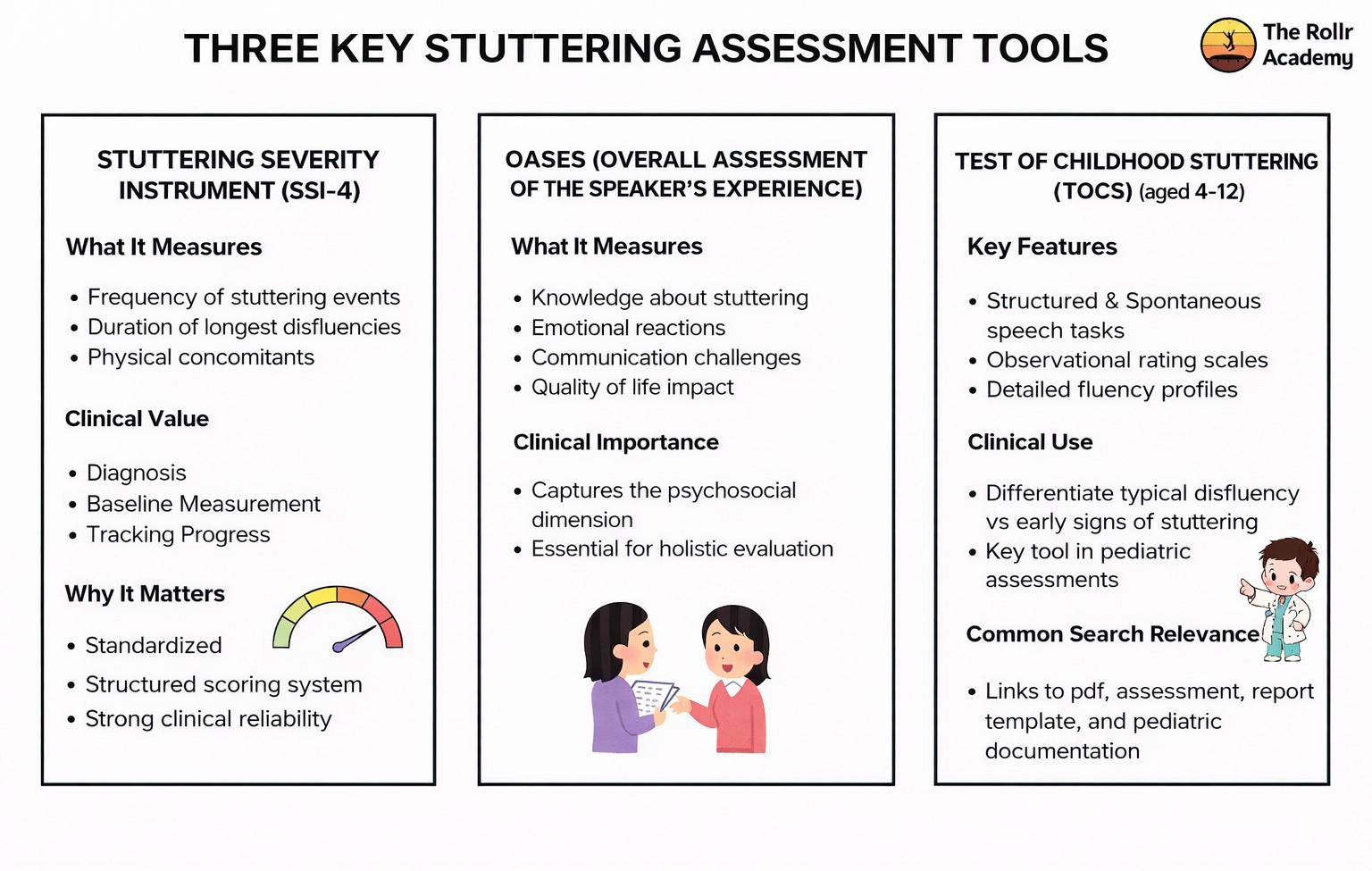
Ref: Key stuttering assessment tools overview
Supplementary Stuttering Assessment Tools
Stuttering Prediction Instrument (SPI)
The Stuttering Prediction Instrument (SPI) is used to identify whether early stuttering is likely to persist in young children.
- Focus: Early identification
- Supports preventive intervention
The SPI helps speech-language pathologists (SLPs) determine whether a child requires immediate intervention or ongoing monitoring. It evaluates risk factors associated with persistent stuttering and supports informed clinical decision-making.
Wright & Ayre Stuttering Self-Rating Profile (WASSP)
The WASSP, a self-report assessment tool, evaluates how stuttering affects individuals' daily communication through the ways in which individuals address both their actions when they stutter and the emotions associated with stuttering during everyday interactions.
- Useful for adolescents and adults
- Encourages self-awareness
- Supports therapy planning
The WASSP is particularly useful in client-centered therapy as it identifies each individual's perspective and helps guide the development of goals according to the individual's needs and experiences.
Communication Attitude Test (CAT)
The Communication Attitude Test (CAT) assesses how children view their communication capabilities. It helps us understand how they perceive their ability to speak and what difficulties exist.
- Identifies negative beliefs about speaking
- Supports cognitive and emotional intervention planning
The CAT is particularly useful for identifying the effects that stuttering may have upon a child's willingness to participate as well as their self-confidence. This allows physicians to address both the emotional and speech-related aspects of assisting the child.
Behavior Assessment Battery (BAB)
The Behavior Assessment Battery (BAB) assesses how stuttering affects a person's behavior, emotional response, and thinking while speaking. This provides insight into how individuals perceive and deal with their speech disorder in a variety of situations that may not have obvious emotional or behavioral responses.
- Measures avoidance behaviors
- Assesses emotional reactions
- Provides a comprehensive perspective
This assessment helps identify how stuttering impacts daily communication and participation. It also provides insight into emotional responses and avoidance behaviors, allowing clinicians to plan more targeted and effective interventions.
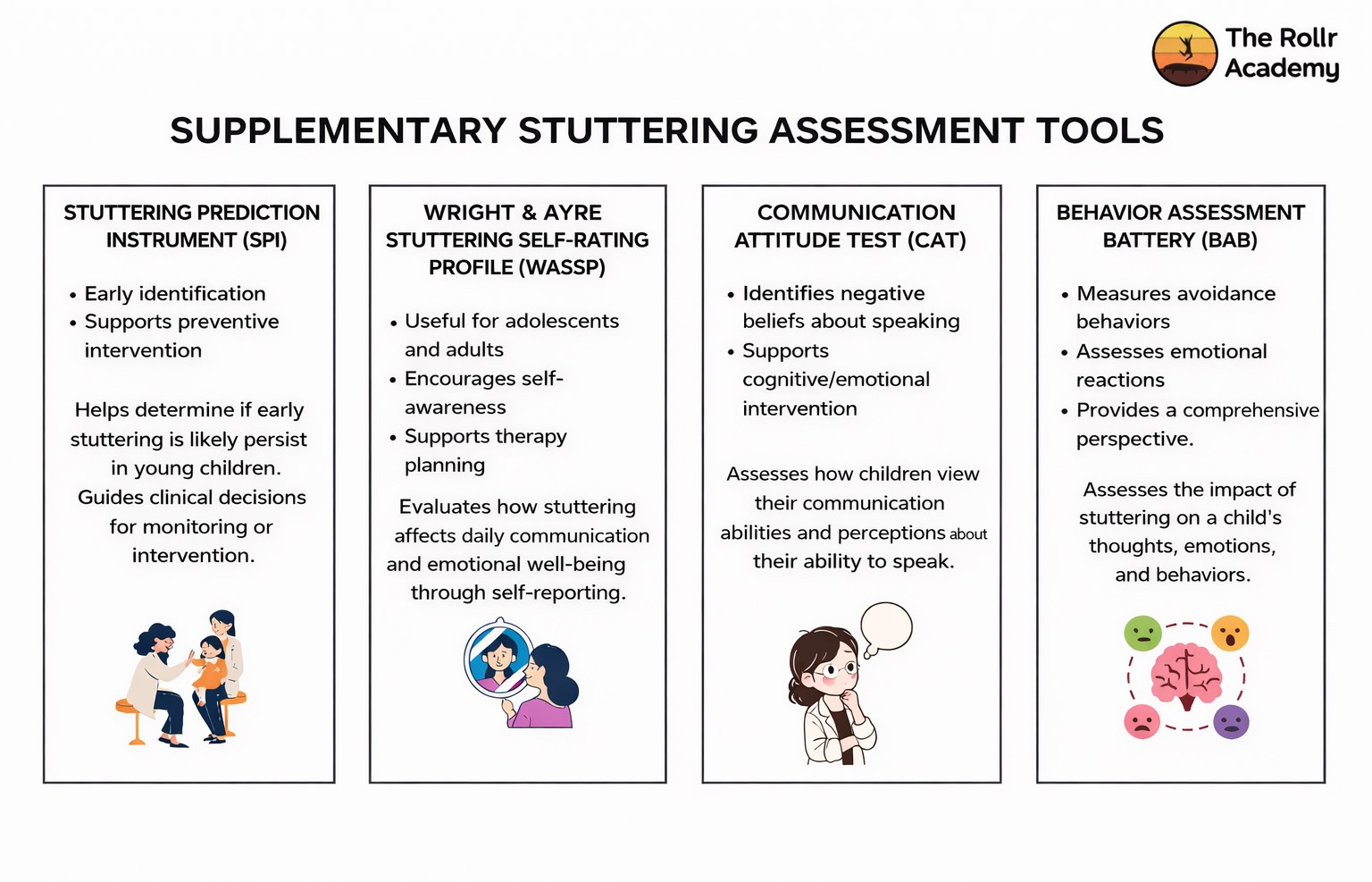
Ref: Supplementary stuttering assessment tools comparison
Stuttering Assessment Tools: Comparison and When to Use
| Tool | Age Group | Purpose | When to Use |
|---|---|---|---|
| SSI-4 | 2+ years (All ages) | Measures stuttering severity | Baseline assessment, tracking therapy progress |
| OASES | 7+ years (School age – Adults) | Assesses impact on daily life & emotional well-being | Evaluating social, emotional, and functional impact |
| TOCS | 4-12 years (Children) | Diagnosed with childhood stuttering | Differentiating stuttering from typical disfluency |
| SPI | 2-5 years (Preschool) | Predicts risk of persistent stuttering | Early identification and intervention planning |
| WASSP | 13+ years (Adolescents – Adults) | Self-perception & personal experience | Therapy planning, goal setting |
| CAT | 7-14 years (Children) | Communication attitudes | Identifying negative beliefs about speaking |
| BAB | 12+ years (Older children – Adults) | Emotional and behavioral impact | Understanding avoidance and coping behaviors |
Clinical Insight
A comprehensive stuttering assessment combines standardized tests, informal evaluations, and self-reports to provide a complete picture for accurate diagnosis and effective treatment planning.
Informal Stuttering Assessment
Informal stuttering assessments evaluate how individuals communicate in real-life situations, helping clinicians understand everyday speech patterns and communication challenges.
Common Methods:
- Conversational speech samples – checking how fluently someone speaks during a normal conversation
- Reading tasks – evaluating speech when reading aloud from a text
- Parent and teacher interviews – getting feedback on how stuttering affects communication
- Naturalistic observation – watching how someone interacts in various situations
One-Page Stuttering Assessment
A one-page stuttering assessment can be used to quickly screen and document the type and severity of stuttering. The typical types of information included in this rapid assessment are:
- Types of speech problems – such as repeating words, stretching sounds, or getting stuck
- How severe the stuttering is – mild, moderate, or severe
- Other behaviors – like tension, body movements, or avoiding certain words
The value of these tools lies in their ability to provide clinicians with insight into an individual's speech patterns. Additionally, they are also useful in supporting the process of documenting changes over time and in supporting more in-depth stuttering assessments.
Free Stuttering Assessment Resources
There are a number of tools available at no cost for the purpose of identifying stuttering in an early fashion. The primary use of these tools is to assist with initial screenings or as educational tools and self-reflective tools, specifically for parents, educators, and individuals.
Common Free Tools include:
1. Screening Checklists
- Informal fluency checklists used by parents and clinicians
- Help identify signs such as repetitions, prolongations, and blocks
- Example: Early stuttering signs checklists from speech organizations
2. Self-Report Questionnaires
- Basic versions of tools similar to OASES-style reflections
- Help individuals understand their speaking experiences and emotions
- Often available as downloadable PDFs or online forms
3. Educational Guides & Toolkits
- Provide structured information about
- Types of stuttering
- Causes and myths
- Coping strategies
- Useful for both families and beginners in speech therapy
4. Awareness & Observation Materials
- Guides for observing speech in real-life situations
- Help track
- When stuttering occurs
- Triggers and patterns
- Often used before a formal assessment
Important Note
The primary role of these tools is for initial screening purposes and to raise awareness of stuttering, but they will never be a replacement for formal stuttering assessments that are performed by qualified Speech-Language Pathologists.
How to Choose the Right Stuttering Assessment
1. Age of the Client
- Preschool: SPI, informal observation
- School-age: TOCS, CAT
- Adults: SSI-4, OASES
Different tools are appropriate depending on the developmental stage and communication needs.
2. Purpose of Assessment
- Diagnosis: Standardized stuttering tests
- Impact analysis: Self-report tools
- Progress tracking: Repeated measures
Selecting the right tool depends on whether the goal is to identify stuttering, understand its impact, or monitor therapy outcomes.
3. Clinical Setting
- Schools: Observational and structured tools
- Clinics: Comprehensive standardized batteries
The choice of assessment should reflect the context and resources available.
Best Practice
No single stuttering assessment tool is sufficient. We need to use a combination of tests and self-report measures, and observational methods to ensure a complete, accurate, and clinically meaningful evaluation.
Final Thought
Stuttering assessment is not just about measuring speech, it’s about understanding the person behind the speech. What we aim for in a comprehensive assessment is to look at fluency, emotions, behaviors, and how they play out in real life.
No single tool can give a complete picture. The best outcomes come from combining standardized tests, informal observations, and self-reports to create a holistic understanding.
In the end, the goal is not just fluent speech, but confident communication and improved quality of life.
Looking for Expert Support?
Understanding stuttering is the first step but applying that knowledge in real clinical situations is what truly makes a difference
- Learn how to assess beyond speech
- Confidently use tools like SSI-4, OASES, and TOCS
- Build skills for real-life evaluation and therapy planning
Take the next step:
The Stutter Academy by TopSpeech Health provides evidence-based learning that helps build assessment skills and confidence in clinical practice.
A New Kind of Support Is Coming
We're working on an app designed to support people who stutter in a practical and structured way. If this resonates with you, you can register your interest below. We'll only reach out with meaningful updates and when the app is ready.
Start Your Journey to Fluent Speech
Join The Stutter Academy — a structured, evidence-based program designed for adults. 15 minutes a day, 100% private.
Frequently Asked Questions
The Stuttering Severity Instrument (SSI-4) is the most commonly used test for stuttering. It checks how often, how long, and what physical behaviors happen when someone stutters.
Speech-language pathologists do a stuttering evaluation using a mix of tests, like SSI-4 and TOCS. They also listen to speech samples, observe the person, and ask them questions. This helps them understand the stuttering and how it affects life.
An informal stuttering test is when someone talks, reads, or is interviewed. This test shows how stuttering happens in life, not just in a test.
Parents can observe how their child speaks and use stuttering assessment checklists for early screening. However, a formal stuttering evaluation by a speech-language pathologist is required for an accurate diagnosis.
Many stuttering tests are needed to get a complete picture. They check stuttering severity, feelings and communication habits. This helps doctors make a diagnosis and plan.
Sources and References
The following authoritative resources informed this article.
ASHA: Fluency Disorders
Practice portal covering assessment and treatment of fluency disorders from the American Speech-Language-Hearing Association.
View SourceThe Stuttering Foundation
Leading nonprofit providing resources, research support, and education about stuttering prevention and treatment.
View SourceStuttering Severity Instrument (SSI-4)
Standardized assessment tool for measuring stuttering severity across frequency, duration, and physical concomitants.
View SourceOASES (Stuttering Therapy Resources)
Self-report tool for evaluating the overall impact of stuttering on a speaker's experience and quality of life.
View Source