





Introduction to R Blends
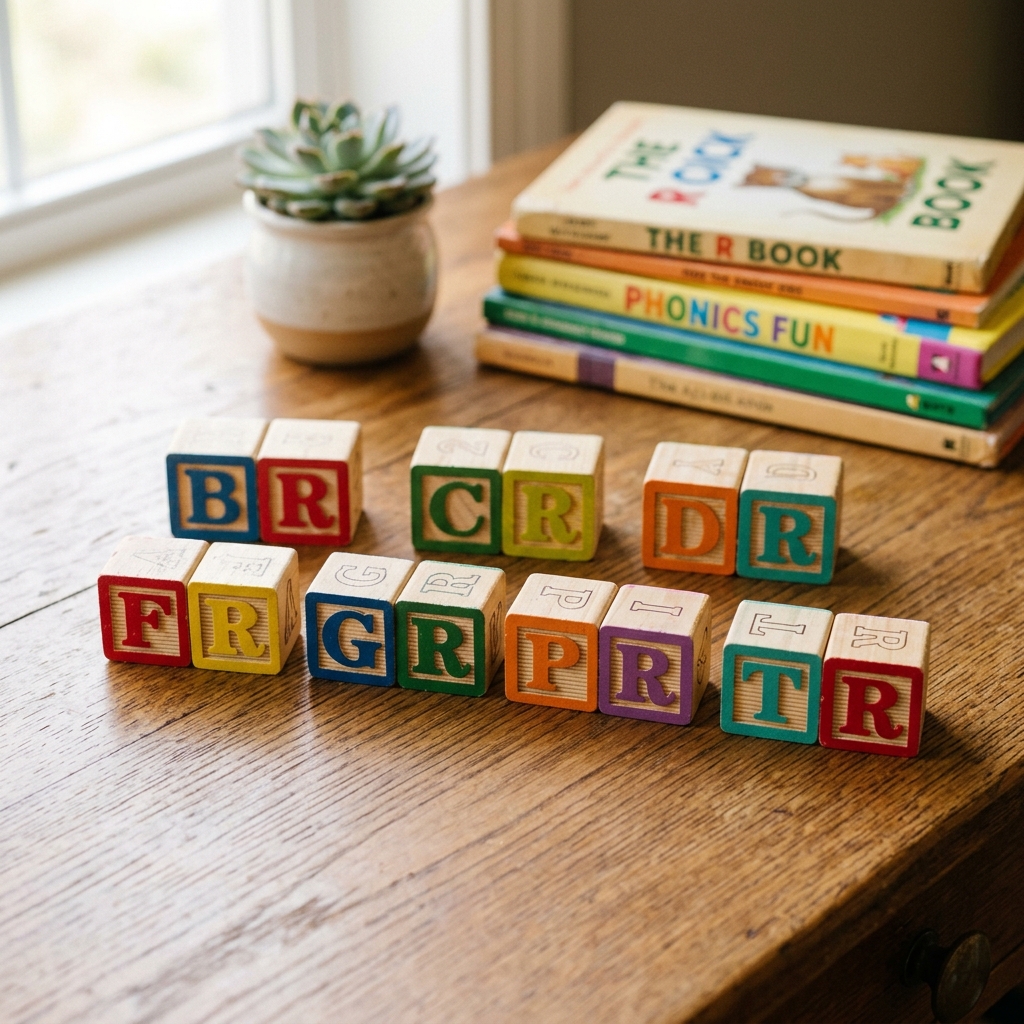
R blends are consonant clusters where "R" is joined with a prior consonant such as br, cr, dr, gr, fr, tr, or pr needing both sounds to be spoken together within a single syllable.
Many people think that the difficult part of learning to speak is learning a whole lot of vocabulary. It is not.
The difficult part is learning to organise your tongue, lips, jaw, and airflow in an arrangement that happens faster than conscious thought. And in linguistics, nothing demands coordination more than 'R blends'.
Say the word 'Dress' right now — notice how the "D" and the "R" didn't take turns but overlapped?
Each one shapes the other within 100 milliseconds. That is called coarticulation, and this is what makes R blends both amazing and difficult at the same time.
If you are a teenager who has spent years quietly self-correcting in class, a parent watching your child struggle with green and train, or an adult who has simply assumed this is just how you talk, this guide is written for you. It covers what R blends are, how many types there are, why certain ones are harder than others, how to practise them effectively, and what speech science says about getting there faster.
If you want a structured programme built around exactly that science, Top Speech Health's Rollr Academy is where to start.
What Are R Blend Words?
The easiest way to think about an "R blend" word is this,
Take a consonant, keep it exactly before "R" for instance: D-r-agon. Speak the word, and notice how you speak both sounds together, in a single syllable, with no vowel in between. That is an R blend.
The word "blend" itself goes back to Old English, which means "mix," and that is what happens: two sounds mix, each one borrowing something from the other.
"R blend" words are everywhere in English. They account for a large proportion of the most common words a child comes across in their first years of reading (National Reading Panel, 2000).
Examples of R Blend Words
Initial R Blends
Initial R blends, as the name states, come at the start of a word. Here are the seven core initial R blends:
| Blend | Example Words |
|---|---|
| Br | Bridge, Brown, Bread, Brush, Brave |
| Cr | Crown, Crab, Crust, Creek, Cry |
| Fr | Frame, Frown, Free, Frost, Frog |
| Dr | Dress, Drive, Drop, Drum, Dragon |
| Tr | Truck, Trip, Train, Trim, Tree |
| Gr | Grow, Grass, Green, Grin, Grape |
| Pr | Proud, Prize, Print, Press, Prank |
Observed the pattern?
Every initial R blend pairs with "r." The mouth first restricts airflow for the first sound, then must quickly release and adjust into the "r" shape. This transition is where the most errors occur.
If you are stuck at exactly this transition, Rollr Academy is built to move you through it, step by step, with feedback.
Medial R Blends
Medial R blends happen inside a word. This includes "r-controlled vowels" or "rhotic vowels" — vowel sounds are reshaped by the presence of the letter "R."
| Blend | Example Words |
|---|---|
| Ar | Card, Hard, Star, Farm, Dark |
| Or | Storm, Sport, Fork, Cord, Born |
| Ir | Bird, Shirt, Girl, Third, First |
| Er | Herd, Term, Fern, Alert, Verse |
| Ur | Surf, Curve, Hurt, Burn, Turn |
Someone who can successfully say "frog" may struggle with "farm." That is phonology, not inconsistency. The vowels in median positions pull the tongue in competing directions, generating a more challenging motor coordination than the one they can already solve.
Think of it this way. Saying frog requires the tongue to start free and move into “r”. Saying bird requires the tongue to move into “r” while the surrounding vowel is already pulling it somewhere else. It is the difference between catching a ball thrown straight at you and catching one that curves mid-air. Same skill. Harder context.
Pronunciation Techniques for R Blends
Assume that you are trying to teach someone how to catch a ball.
You would not go ahead and describe to them the physics of trajectory first. You would give them a ball, stand close, and throw it gently. Continue this a couple of times, and then you would move further back, and then throw the ball faster. The skill builds through progression, repetition, and not through explanation.
Pronunciation works the same way.
The "R sound" is produced by either bunching the tongue mid-mouth or retroflexing the tongue tip at the roof of the mouth. Both strategies create the same sound; neither is wrong.
When a second consonant comes before "R," the mouth must complete the first sound while already beginning to position for the second. Here is what it demands for different blends:
- Br and Pr: The lips close entirely for "B" or "P" , then open while the tongue synchronously shifts into "R" position. Many people round their lips slightly through this transition, which is normal and helpful.
- Dr and Tr: These are considered the hardest initial R blends. The tip of the tongue must touch the alveolar ridge for "D" or "T" , then immediately retract for "R." This is the reason why some young children produce "Dq" or "Tw"
- Cr and Gr: The back of the tongue rises for "c/k" or "g" then drops and retracts for "r." Once the person understands that the front of the tongue stays uninvolved, these blends improve quickly.
- Fr: Lower lip contacts the upper teeth for creating the "f" sound, then lowers as the tongue moves into "r." It is one of the most stable blends across age groups, acoustically.
Three techniques have strong support in the clinical literature:
- Technique 1: Compare "bray" vs. "ray." Hear the difference before creating it. This activates phoneme discrimination before the motor system must act.
- Technique 2: Hold the first consonant for a full second, then slowly transition into "r" "bbbbbb-rrrr" collapsing the gap over successive trials. This directly applies principles of motor learning for speech production.
- Technique 3: Watch your lip movement in a mirror during br and pr blends. The slight lip rounding that precedes "r" should be visible. If it isn't, start there.
Help for Pronouncing the Trilled /r/ Sound
When you are learning Russian (картавость), Spanish (rhotacismo), or Italian (erre moscia), you may be targeting the alveolar trill:
"The rolling R" that comes in words like pero, caro, etc. This requires the tongue tip to vibrate against the alveolar ridge multiple times rapidly.
This is not a talent problem. It is a practice problem.
Neurological research confirms that encoding a new motor pattern requires an average of 400 to 600 repetitions (Schmidt & Lee, 2011).
Most people stop at 20 and conclude they can't do it. The tongue can learn the trill. It simply hasn't done enough repetitions yet.
If you want a structured path built around exactly this acquisition curve, with measurable progress, Top Speech Health's Rollr Academy is a self-paced programme for teens and adults working on r sounds, including the trilled /r/, built on the same motor learning principles described throughout this guide.
Practice Strategies for R Blends
R Blend Word List
A word list is only as useful as the order you use it in.
Most people start with the words they already know and avoid the ones that feel uncertain. That is the wrong approach. The words that feel uncertain are exactly where the learning is. Research on motor skill acquisition consistently shows that practising at the edge of your current ability produces faster long-term gains than practising within your comfort zone (Schmidt & Lee, 2011).
What Are CCVC Words?
CCVC stands for Consonant-Consonant-Vowel-Consonant, a four-unit syllable pattern used in early phonics to teach children how consonant blends function inside a word. Frog, trip, crab, and drum are all CCVC words, and so is nearly every beginner-level R blend word on this page.
Here is a three-tier word list, organised by phonological complexity:
💡 Practice Tip
Don't work down a list. Work across it. Alternate between blends each session — br, then gr, then tr — rather than exhausting one blend before moving to the next.
Rollr Academy's programme sequences this automatically, so you are always practising at the right level, in the right order. See how it works ->
Further R Blend Word Practice Using Short Phrases and Sentences
Here is a gap that most practice programs miss.
A speaker learns "frog" in isolation, then at home they say "fwog" 🤦 in conversation. The speech therapist is confused, the parents are frustrated, and the person feels like they have progressed backwards.
In reality, they haven't; they have revealed the real challenge: isolated word progression is not enough for conversational speech.
This is one of the most documented findings in articulation therapy literature and it is why phrase-level practice matters from early on.
The strategy: Use sentences where r-blend words cluster together. The coarticulation pressure of multiple blends in a single utterance forces the articulators to generalise the pattern far more effectively than spacing them apart.
Try these:
• "The frog jumped from the bridge." — three blends, natural rhythm
• "Brian brought a brown crate to the driveway."
• "Crabs crawl across the grass near the creek."
• "She pressed the print button and grabbed the draft."
Start slowly. The goal is correct production, not speed. Speed builds itself once the motor pattern is encoded.
Games & Activities with R Blend Words
Repetition is the key to motor learning.
But repetition without purpose is just drilling. And drilling is boring. Boredom kills compliance. And without compliance, no amount of phonological knowledge produces any change at all.
These activities embed repetition in something that doesn't feel tedious:
- Blend Bingo: Speak multiple R blend words while players mark their cards. Each correct production earns a mark. Works from age four through adulthood.
- R Blend Word Chains: Start with crab, the next word must begin with the last sound: crab → brown → nest → train... Requires spontaneous production under low pressure.
- Picture Sort: Sort image cards into columns by blending all "gr" words in one pile, all "br" in another. The naming-and-sorting loop creates repetitions without the learner realising how many they're getting.
- BOOM Cards (digital): Self-checking digital flashcard decks where learners click the correct image for each r blend word they hear. Immediate self-correction is a key requirement of effective feedback loops in motor learning.
- Story Retelling: Read a short passage dense with r blend words. Ask the learner to retell it in their own words. Spontaneous production with no word list in sight is the highest level of generalisation.
Advanced Techniques and Resources
Using Auditory Feedback to Upgrade Sound Practice
There is a feedback loop inside every act of speaking.
You produce a sound. Your ears receive it. Your brain compares it to the target. If there's a mismatch, your brain adjusts. This loop the auditory-motor feedback loop, is one of the primary mechanisms by which people self-correct and improve their own speech over time.
A 2012 study found that altered auditory feedback approaches significantly affected vowel production accuracy in speakers with articulation differences (Cai et al., 2012, JASA).
The same principle is at the core of Top Speech Health's Rollr Academy program: learners speak, and the program plays back exactly how they sounded to an outside ear no autocorrection, no judgment, just an honest mirror.
Most people have never heard themselves the way others do. That gap between internal perception and external reality is precisely where change begins, and Rollr Academy is built to close it.
CCVC R Blends Set for Phonics Practice
CCVC stands for Consonant-Consonant-Vowel-Consonant.
It is the syllable structure of words like frog, trip, crab, and drum. It is also the primary syllable shape targeted in most phonics curricula between ages five and seven (National Reading Panel, 2000).
Understanding CCVC structure is not just useful for phonics teachers; it also helps parents understand exactly why these words are harder than three-letter CVC words and exactly where to apply pressure in practice.
Three tools are particularly effective with CCVC R blend sets:
- Word work chains: Change one phoneme at a time: crab → grab → grad → grit → brit → brat . This isolates the blend as the variable and trains the learner to hear how blends operate within a word's structure.
- Blend ladders: Vertical word lists where each rung changes only the initial blend: brag / crag / drag / shag. The sound that stays constant anchors the learner; the sound that changes is the one being trained.
- Sound box mapping: Write the word in boxes separated by sound [cr][a][b] and tap each box while producing the corresponding phoneme. Research on phoneme segmentation confirms that this tactile reinforcement accelerates phonological awareness gains.
The most important thing about CCVC R blend work is not the specific tool you use. It is the consistency with which you return to it.
Ten minutes a day, five days a week, outperforms one hour on the weekend.
Conclusion
R blends are some of the most phonologically demanding sounds in English. They require two articulation targets to be met simultaneously, at speeds the conscious mind cannot directly control. They are present in thousands of high-frequency words. And they are the source of genuine frustration for children, adults, and the people who love them.
But R blends respond to structured practice. Motor learning is real. The tongue can be trained. Seven-year-olds who once said "gween" for green go on to say great and grand and gratitude without thinking twice about it. Adults who spent decades avoiding the word three find their way back to it through patient, deliberate repetition.
The research is detailed on the mechanism. What's needed is the right environment to apply it.
Rollr Academy gives you that environment, structured sessions, audio feedback showing you exactly how you sound to others, and a 3-day free trial so you can decide without risking anything.
Ready to Start Your Speech Progress?
If you want a structured program that tracks your progress from first session to fluency — built on the same motor learning principles described in this guide — Top Speech Health's Rollr Academy was built for exactly this.
Start your 3-day free trial today!

Frequently Asked Questions
R blends are consonant pairs in which /r/ follows another consonant at the start of a syllable, requiring both sounds to be produced together. The seven standard initial r blends in English are: br (bread), cr (crab), dr (drum), fr (frog), gr (green), pr (print), and tr (train). Including three-consonant blends such as shr and thr brings the total to nine.
There are seven primary initial r blends in English: br, cr, dr, fr, gr, pr, and tr. Some classification systems include shr (shrimp) and thr (three), raising the count to nine. Medial r-controlled vowel combinations ar, or, ir, er, ur form a separate category sometimes called r blends in the middle of words.
Common words starting with r blends include: brave, crab, drum, frog, green, prize, train (beginner level) and bridge, creep, drink, frame, greet, proud, trust (intermediate).
Produce the first consonant, then transition immediately into /r/ without inserting a vowel between the two sounds. Broom is /br-oom/, not /buh-room/. The most effective learning technique is slow blend chaining — hold the first consonant for a full second, then gradually collapse the gap over repeated trials.
Most children master individual r blends by age 7 to 8, following acquisition of the single /r/ phoneme, which typically emerges by age 6. Blends require coordinating two phonemes simultaneously, so they lag slightly behind single-sound acquisition. Errors persisting past age 8 warrant evaluation by a speech-language pathologist.
Sources and Clinical Research
The following peer-reviewed studies, clinical guidelines, and authoritative resources informed this article.
McAllister Byun, T., & Hitchcock, E. R. (2012). Emerging Technologies for the Treatment of Rhotacism. AJSLP, 21(3), 207–221.
Examined biofeedback modalities for rhotacism directly relevant to understanding /r/ production mechanics in r blend contexts.
View SourceAmerican Speech-Language-Hearing Association (ASHA). (2023). Articulation and Phonology. ASHA Practice Portal.
Establishes age-of-acquisition norms for phonemes, including /r/ and consonant blends; defines clinical thresholds for assessment referral.
View SourceMaas, E., Robin, D. A., et al. (2008). Principles of Motor Learning in Treatment of Motor Speech Disorders. AJSLP, 17(3), 277–298.
Provides the evidence base for varied practice schedules and feedback frequency in speech motor learning.
View SourceNational Reading Panel (NRP). (2000). Teaching Children to Read. NICHD.
Foundational document establishing the role of phonological awareness and phonics instruction, including CCVC syllable pattern work in reading and speech development.
View Source