







What is R Speech Therapy?
R speech therapy is a structured and evidence-based approach that helps children, teens, and adults learn how to correctly pronounce the "R" sound — one of the most commonly mispronounced sounds.
When words like girl, rabbit, or world become difficult to say, you may be dealing with Rhotacism — the clinical term for difficulty producing the "R" sound.
What is an R Speech Impediment?
An R speech impediment, clinically known as Rhotacism, is a speech sound disorder where a person has difficulty correctly pronouncing the "R" sound. It often results in substituting or distorting R in words like rabbit, car, or world.
Instead of saying:
- rabbit → wabbit
- car → cah
- girl → guhl
The speaker mispronounces the R sound.
Understanding Rhotacism
Variations of the R Sound
The reason that Rhotacism errors are persistent is because it does not have just one R sound. There are 2 types of R sound which are Retroflex R and Bunched R. Both have different tongue shapes, allow me to show you the difference.
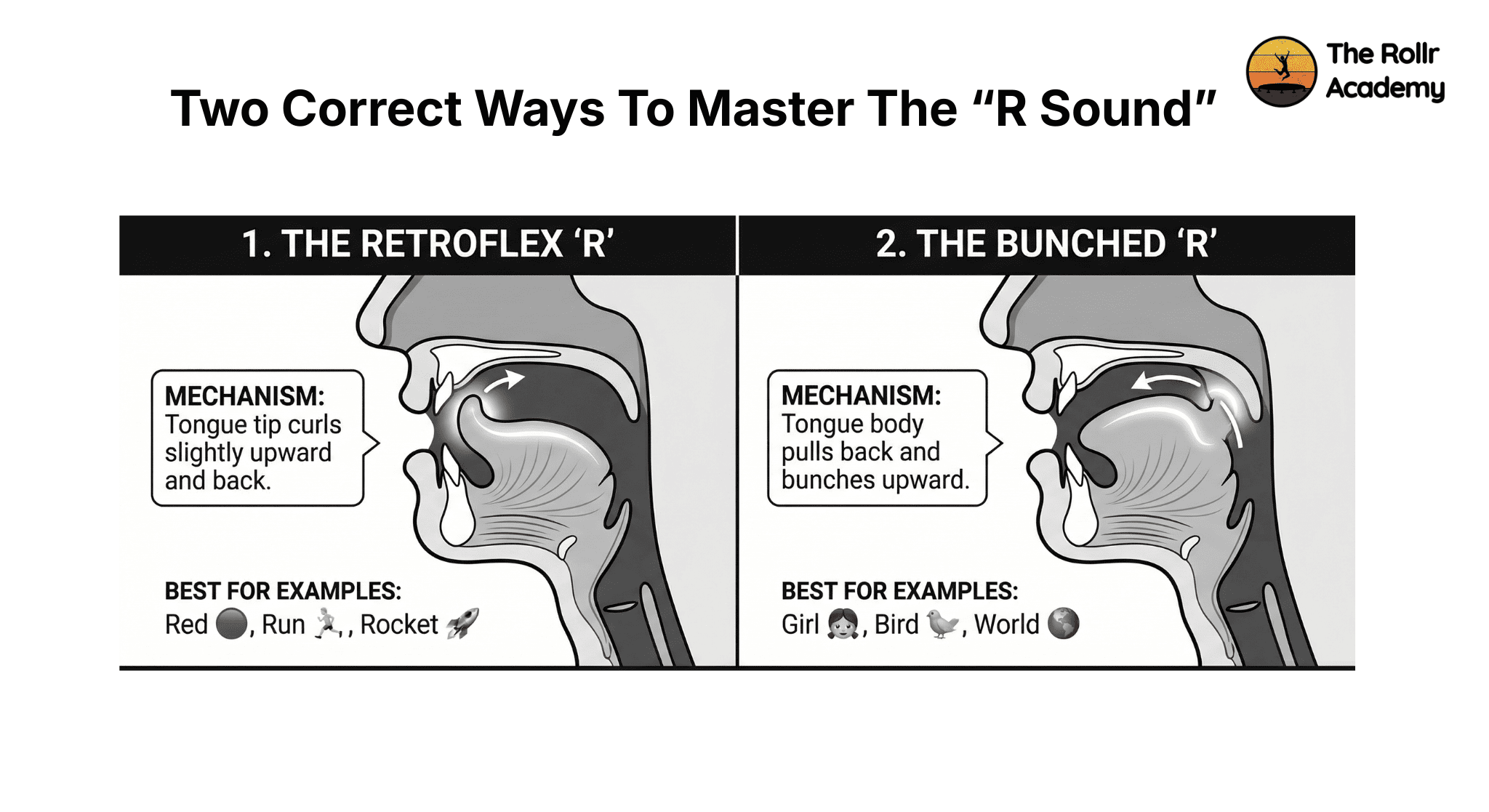
Source: The Rollr Academy – Two Correct Ways To Master The "R Sound"
Speech therapy focuses on finding which tongue position works best for each learner.
Identifying the Root Causes of Rhotacism
You must have wondered, “What causes Rhotacism?”
There are multiple reasons that influences the causes of rhotacism:
- Motor Coordination issues
- Delay in speech development
- Formation of wrong pronunciation of “R sound” Habit
- Hearing and Sound Processing
Rhotacism is the most common speech impediment error that continues even into adulthood.
Once the brain learns the incorrect tongue movement, the pattern continues throughout adulthood but it can be corrected at any age with structured and consistent speech therapy.
You can explore a screening option through a structured free rhotacism test.
Challenges Presented by Rhotacism
Rhotacism can affect everyday communication.
Children may:
- avoid reading aloud
- hesitate to speak in class
And Adults may:
- avoid words containing R
- feel self-conscious in meetings
- experience reduced speaking confidence
The Importance of Early Intervention
In R speech therapy, "early intervention" is typically associated with childhood — but at Top Speech Health, we redefine it.
Early intervention means addressing the R speech error the moment it starts impacting your life. 90% of children do learn the R sound by the age of 7, but many people carry residual rhotacism into adulthood.
The simple logic: it is better and more effective to start at 15 than to wait until 32.
The bottom line: While the biological window for natural acquisition is closed, the clinical window for excellence is wide open. For an adult, the most effective "early intervention" is the one that starts today.
How Long Does R Speech Therapy Take?
The progress ranges from:
- 8–12 weeks for mild cases
- 3–6 months for persistent errors
Progress depends on three main factors:
- Consistency of practice
- Structured speech technique
- Motor learning differences
Short Practice session everyday often produce faster results than occasional long sessions.
The Role of Speech Therapy in Treating Rhotacism
The speech therapy for rhotacism has the motto to help you learn the proper tongue movement, airflow and coordination which is needed to produce the perfect “R sound.”
Speech therapy is not about perfecting the speech habits through willpower but teaching the motor system correct, accurate repeatable tongue shape.
Therapy objectives include:
- Diagnosing whether the Retroflex or Bunched tongue position works well for the individual.
- Perfecting the correct sound productions at the syllable level before going forward to words.
- Slowly progressing from practices to use the R sound in conversations.
- Feedback-based learning to correct the errors.
Treatment for Rhotacism
One of the most amazing advances in Rhotacism treatment is using “structured conversation based feedback” to help people understand how their speech is actually sounding in real life conversations.
But What is Conversation-Based Speech Feedback?
Conversation-based feedback helps users practise real-life speaking by asking open-ended questions that encourage natural responses.
- What is your favorite book and why?
- How was your weekend?
- What did you do this morning?
- How was your day?
We use a proprietory speech analysis that generates live transcript of what you speak without auto correcting your pronunciation.
This feature helps in understanding the difference between how others actually hear your speech and how you think you sound
Conversation-Based Speech Feedback in the Rollr Academy Program
Why did technique improve R speech therapy outcomes?
The “R sound” has a tendency to become inconsistent when the pronunciation shifts to communication. And real time transcriptions help understand whether the correct tongue position is happening or not during natural conversations.
Top Speech Health's The Rollr Academy uses conversation-based feedback directly inside your practice sessions.
As you speak words containing the R sound, the system captures your speech and displays a real-time transcript exactly as spoken, helping you notice patterns in pronunciation and guiding you to adjust your tongue position more accurately.
Techniques and Strategies for R Speech Therapy
Specific Techniques for Teaching the R Sound
As covered earlier, your SLP will identify whether the retroflex or bunched tongue shape works best for your mouth anatomy. Once you know which one fits, here is how to actually produce it:
Retroflex — Step by Step
- Raise your tongue tip slowly upward, stop before it touches the roof of your mouth
- Keep the sides of your tongue slightly raised
- Let voiced air flow through the centre of your mouth
- Hold that shape and sustain the R sound for 3–5 seconds
Bunched — Step by Step
- Pull your tongue slightly backward without touching your back teeth
- Raise the middle of your tongue upward, not the tip
- Press the sides gently against your upper back molars
- Hold and sustain the R sound for 3–5 seconds
R Blends Mommy Speech Therapy Technique
R blends Mommy Speech Therapy technique uses “consonant clusters” which helps the brain to transition smoothly into the “R sound.” The blending technique improves coordination across various sound environments and improves motor flexibility.
Common R Blends Examples:
| Blend | Example Words |
|---|---|
| BR | brown, bring |
| TR | tree, truck |
| DR | dream, drop |
| GR | green, grow |
| PR | proud, print |
| CR | crown, craft |
| FR | frame, frog |
Fun and Engaging R Sound Activities
Motivation improves consistency and consistency results in improvement. These activities are not a chore but a more improved engaging practice.
R Word Scavenger: Find the objects around you that has the “R sound” in it
Record and Listen Session: Use your voice recorder in the phone and playback, evaluate yourself.
Story games: You should build short stories by using only the “R words” in it.
Pair Practice: Repeat word pairs like “rake-wake” or “Red-wed” and listen the difference between them when you speak.
Targeted Speech Therapy Exercises
Rip Rug Run Exercise Progression
Start with Isolated syllables
ra re ri ro ru rah
Then practice words (Prevocalic R)
rip rug run red rock ring roof race
Remember: Phrases first, then sentences and then conversations.
R Words Speech Therapy Exercises
Beginning R:
- Rabbit
- Rainbow
- Rocket
- River
- Radio
- Read
Middle R:
- Carrot
- Cereal
- Pirate
- Forest
- Mirror
- Parent
Ending R:
- Car
- Bear
- Chair
- Star
- Door
- Floor
Repeated exposure improves motor planning.
150+ Vocalic R Words Practice
Common patterns:
| Pattern | Examples |
|---|---|
| AR | car, star, farm, barn, yard, dark, park |
| ER | teacher, flower, mother, butter, letter, water |
| IR | bird, girl, first, circle, third, shirt |
| OR | corn, storm, fork, sport, short, door |
| UR | nurse, turn, purple, curve, church, burger |
You have seen the pattern. Now practice with the complete list.
Get our comprehensive list to all 7 Vocalic R patterns. From "RL" combinations to complex sentences, we’ve mapped out 150+ ways to help you find your voice. Ready to print or practice on the go.
400+ Prevocalic R Words Practice
Examples
| Rain | Rope | Ring | Road | River |
| Rocket | Radio | Reach | Race | Roof |
| Round | Rush | Rise | Right | Row |
You have seen the pattern. Now practice with the complete list.
Get our comprehensive list to all 7 Vocalic R patterns. From "RL" combinations to complex sentences, we’ve mapped out 400+ ways to help you find your voice. Ready to print or practice on the go.
Helping Adults Overcome Rhotacism
If you are an adult reading this, you have probably assumed or been told that speech cannot change after a certain age.
Adults have many advantages in speech therapy:
- You can understand the practice instructions clearly and you can self-correct yourself.
- You can practice independently with structured tools/apps.
- You can use new patterns directly in conversations from literally day one!
- Your motivation is higher, because you are choosing to improve your speech impediment, not being brought to therapy.
The barrier for adults is not the ability but understanding the correct tongue position in the first place. Once this is studied, progress can be improved at a faster pace. Many adults see immense improvements within 8-12 weeks of consistent everyday practice.
See your R sound in real time. Practice with purpose.
The Rollr Academy Program uses Visual Bio Feedback — the same approach used by licensed SLPs — so you can see exactly whether your R sound is hitting the right frequency target.

Conclusion
Rhotacism is one of the most common speech challenges that carries into adulthood but it is also treatable. The research is clear: with the right technique, consistent practice, and the correct tongue position identified earlier, meaningful improvement is possible at any age.
Whether you are a teen who has carried this since childhood, an adult who has quietly avoided certain words for years, or someone who simply wants to communicate with more confidence, the path forward is the same. Structured practice. Evidence-based technique. And a tool that gives you real feedback, not just guesswork.
That is exactly what Top Speech Health was built for.
Our Program guides you through the same motor-learning approach used by licensed speech-language pathologists with visual feedback that shows you in real time whether your R sound is hitting the right frequency. You are not practicing in darkness, you can see your progress in real time.
How Top Speech Health Supports R Sound Therapy ?
At Top Speech Health, our resources are developed in line with ASHA clinical guidelines and designed to complement professional speech-language therapy. Whether you are a parent tracking your child's progress, an adult working independently, or an SLP looking for structured materials, our tools are built around evidence-based motor learning principles. Start with our free rhotacism screening tool.
Sources and Clinical Research
The following peer-reviewed studies, clinical guidelines, and authoritative resources informed this article.
Children's English Consonant Acquisition in the United States
A comprehensive review analyzing data from 15 studies (18,907 children) to determine the typical age and pattern of English consonant acquisition.
View SourceReevaluating the classification of pediatric speech sound disorders
A ground truthing perspective
View SourceRhotic Acquisition Is More Rapid in Bio Feedback Than Motor-Based Treatment for Residual Speech Sound Disorder:
Primary Outcome of a Randomized Controlled Trial.
View SourceThe Business Research Company (2025). Speech Therapy Services Market Report 2026
Market overview and growth analysis for speech therapy services worldwide.
View Source