







Introduction
The R-blend words are consonant clusters where the letter "R" is grouped with another consonant at the beginning of a syllable. For example, "br, gr, pr, dr, fr, and tr." The speaker needs to produce both sounds rapidly for clear speech. You may notice that some people pronounce "truck" as "tuck" or "frog" as "fog." Proficiency in r-blend words is an important milestone in speech clarity and phonological development.
This article explains what R blends are, why they matter, provides complete word lists, and shares step-by-step articulation strategies.
Understanding R Blends
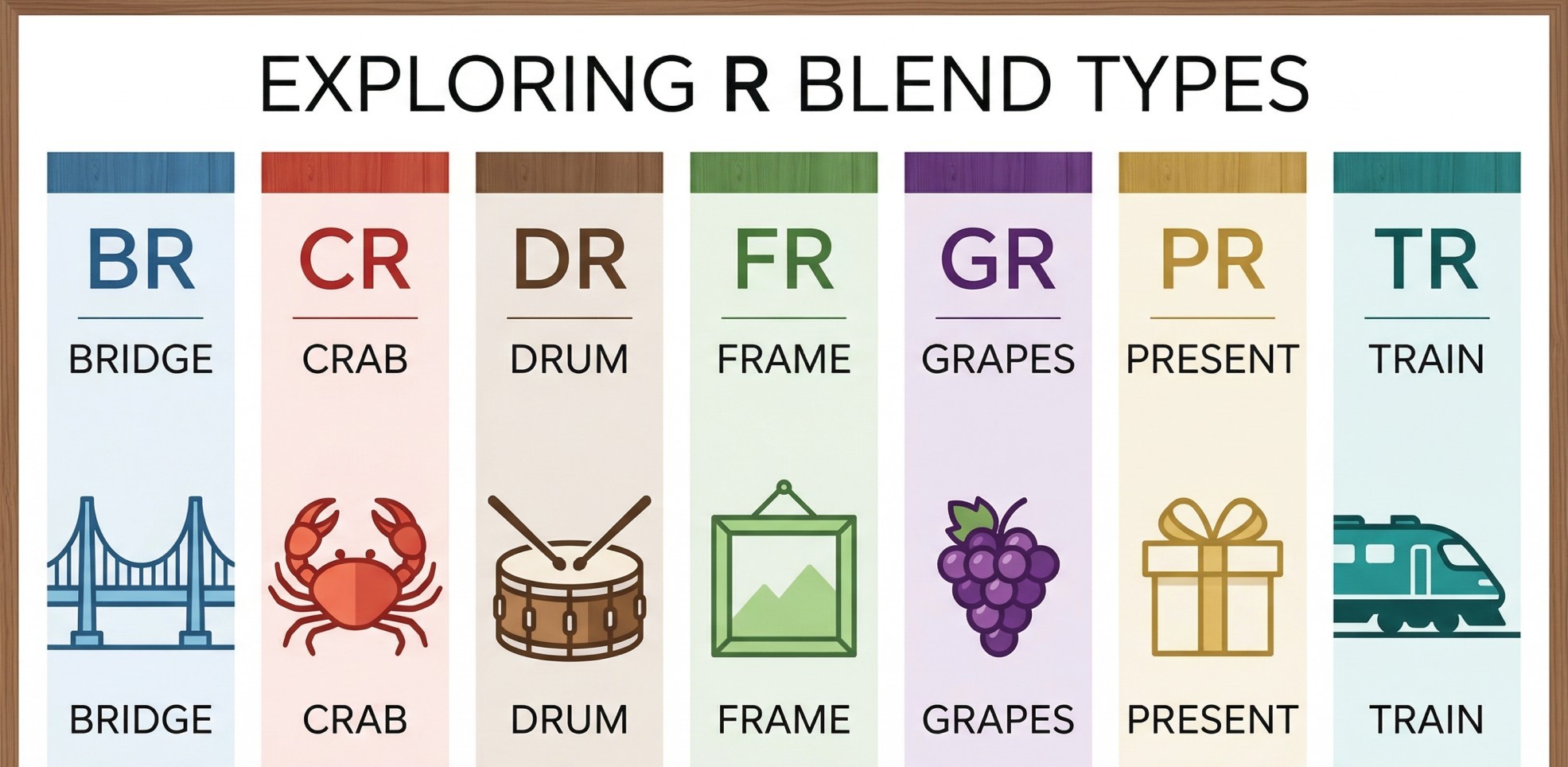
The seven types of R blends with example words
There are seven core R blends: br, cr, dr, fr, gr, pr, and tr.
Each R is paired with a consonant before a vowel follows. A blend has the individual phoneme value of each consonant, unlike the digraph (like ch, th, or sh), where two letters come together to form a sound. So in cloth, the "th" becomes a sound, whereas in frog, both "f" and "r" are heard, which is what makes it an R blend word.
R Blends vs. L Blends vs. Digraphs: What Is the Difference?
Here is a clear comparison of all three phonics terms:
| Feature | R Blends | L Blends | Digraphs |
|---|---|---|---|
| Examples | br, cr, dr, fr, gr, pr, tr | bl, cl, fl, gl, pl, sl | sh, ch, th, wh, ph |
| Number of sounds | Two (both heard) | Two (both heard) | Two letters → One sound |
| Difficulty level | High – "R" is the last consonant | Moderate | Varies by digraph |
| Common error | "R" replaced by "w" ("fwog") | "l" replaced by "w" ("bwue") | Just a single sound |
This table is useful to understand whether you or your loved one is facing difficulty with blends or digraphs.
Importance of R Blends in Speech Development
Speaking R blends with accuracy is not just a milestone, but it also helps in phonological awareness, spelling accuracy, and reading fluency.
Approximately 24.6% of children between the ages of 3 and 6 have some form of speech sound disorder, with "R" and R blend errors frequently reported (McLeod & Crowe, 2018, JSLHR).
Apart from academics, persistent R blend errors affect social confidence. People who are misunderstood or who self-correct themselves with embarrassment may avoid public speaking, debate groups, social gatherings, etc. Addressing R blend words early, with the correct strategies, protects both communication development and emotional well-being.
Articulation and Pronunciation
Tap a word to hear the pronunciation, or click the mic to practice recording yourself.
Common R Blends
Below is a complete R blend word list, progressing from beginner to advanced within each category.
BR Words
BeginnerTap to hearRecord this word, hear how you sound
IntermediateTap to hearRecord this word, hear how you sound
AdvancedTap to hearRecord this word, hear how you sound
CR Words
BeginnerTap to hearRecord this word, hear how you sound
IntermediateTap to hearRecord this word, hear how you sound
AdvancedTap to hearRecord this word, hear how you sound
DR Words
BeginnerTap to hearRecord this word, hear how you sound
IntermediateTap to hearRecord this word, hear how you sound
AdvancedTap to hearRecord this word, hear how you sound
FR Words
BeginnerTap to hearRecord this word, hear how you sound
IntermediateTap to hearRecord this word, hear how you sound
AdvancedTap to hearRecord this word, hear how you sound
GR Words
BeginnerTap to hearRecord this word, hear how you sound
IntermediateTap to hearRecord this word, hear how you sound
AdvancedTap to hearRecord this word, hear how you sound
PR Words
BeginnerTap to hearRecord this word, hear how you sound
IntermediateTap to hearRecord this word, hear how you sound
AdvancedTap to hearRecord this word, hear how you sound
TR Words
BeginnerTap to hearRecord this word, hear how you sound
IntermediateTap to hearRecord this word, hear how you sound
AdvancedTap to hearRecord this word, hear how you sound
Speech Therapy Exercises for R Blends
Rip, Rug, Run: Speech Therapy Exercises for Remediation of the R Sound.
Structured practice improves motor planning and articulation accuracy (McLeod, 2009).
1. Isolation Practice
Practice the "r sound" alone before combining with consonants. For example, roll the tip of your tongue on the roof of your mouth and try pronouncing "Aaa-R."
2. Segmentation Drill
Break words into sounds: b + r + e + a + d until it becomes "BREAD"
3. Minimal Pair Contrast
fog vs frog
tick vs trick
pane vs plane
Helps children hear sound differences clearly.
4. Repetition Ladder Progression
sound → syllable → word → phrase → sentence → conversation
Example progression:
br
broom
blue broom
The blue broom is big.
5. Visual Tongue Cue Method
Encourage them to:
- slightly curl tongue back
- keep lips relaxed
- maintain steady airflow
6. Daily 10-Minute Practice Structure
- 3 minutes of R sound drills.
- 3 minutes of word practice, such as frog, train.
- 2 minutes of reading sentences that consist of R words.
- 2 minutes of conversation practice.
Consistency improves outcomes significantly (ASHA).
Help for Pronouncing the Trilled R Sound
What is the Trilled R sound?
A Trilled R sound is produced when your tongue vibrates rapidly as air passes over it, creating a rolling sound like: "rrrrrrr."
It sounds like the tongue is drumming or fluttering inside the mouth.
The tip of the tongue is placed against the alveolar ridge (bumpy area just behind the upper front teeth).
Languages that commonly use trilled R:
- Spanish → perro, rojo
- Italian → Roma
American English R is typically smoother and does not vibrate.
Teaching the R Sound
How to Teach the R Sound in Speech Therapy: 6 Steps to Mastery
Evidence-based therapy follows a structured progression (ASHA):
- Establish correct tongue placement
- Practice isolated sound
- Introduce blends gradually
- Practice in structured word lists
- Build phrases and sentences
- Generalise them into daily conversation
Proficiency depends on repetition and consistency.
R Words Speech Therapy Exercises
Effective therapy activities include:
- Articulation flashcards
- Repetition games
- Storytelling prompts
- Fill-in-the-blank sentences
- Picture naming
- Reading passages
Speech therapy is more effective when it becomes engaging and interactive.
A well-structured R-word practice is effective when the targets are arranged by place of production, syllable position, and blend type. For each blend type, work through this sequence:
- Word-initial blend in isolation (frog)
- Blend a word in a carrier phrase ("I see a frog")
- Blend words in a short sentence ("The frog jumped over the log")
- Blend words in spontaneous connected speech
Rotate across blend types (br, cr, dr, fr, gr, pr, tr) within a session to make this exercise effective.
R Controlled Vowel Words
Overview of R Controlled Vowels
R-controlled vowels occur when "r" influences vowel pronunciation:
- ar (car)
- er (her)
- ir (bird)
- or (corn)
- ur (fur)
- air/are (chair, care)
These are not R blend words; there is no onset consonant cluster, but they share the same fundamental articulatory challenge: the complex "R" posture that makes this phoneme the most individually variable in English (Zharkova et al., 2020, Clinical Linguistics & Phonetics).
Pro-Tip
These two are often confused because they both require the same tricky tongue posture. Here is the simple difference:
- R Blends (frog): The R shares the sound with a consonant. You hear both "f" and "r".
- R-Controlled (car): The R bosses the vowel. It changes the "a" into a completely different sound.
The Takeaway: If a student can say "car" but struggles with "frog," the issue isn't the "R" sound; it's the quick transition between the two consonants. Distinguishing these helps you target the right motor skill!
Comprehensive Vocalic R Words List for Speech Therapy
Below is a curated vocalic R word list across the five core patterns, suitable for parallel practice alongside R blend word targets:
AR words: arm, art, barn, car, card, dark, farm, hard, jar, lark, march, park, shark, star, yard
ER words: fern, germ, her, herd, nerve, perch, serve, term, verb, verse
IR words: bird, birth, circle, dirt, firm, first, girl, shirt, skirt, stir, third, whirl
OR words: born, cord, corn, fork, form, horn, more, pork, port, short, storm, torch, worn
UR words: burn, burst, curl, curve, fur, hurt, nurse, purse, surf, turn, urge
Additional Resources for Practitioners
150+ Vocalic R Words, Phrases, Sentences, and Reading Passages
Useful for structured articulation therapy progression.
1000+ R Words, Phrases, Sentences, and Reading Passages Grouped by Place, Syllable, & Blend
This is Top Speech Health's most comprehensive R sound clinical resource. Over 1,000 targets are grouped by place of production, syllable count, and blend type.
Initial R Blends Articulation Sheets
Printable worksheets support home practice and therapy sessions.
Can be used by SLPs or for at-home sound exercises. 10 minutes a day
Addressing R Sound Impediments
Rhotacism: "R" Speech Impediment in Children
Rhotacism is the word clinicians use for difficulty producing the "R" sound, including when it appears in R blend words like frog, truck, or bread. When you or your loved one says "fwog" instead of frog, or "twuck" instead of truck, that is rhotacism in action.
Affected people may substitute:
- w → rabbit → "wabbit"
- l → rabbit → "labbit"
Speech therapy significantly improves intelligibility and confidence when intervention begins early.
Rhotacism is not caused by laziness or by anything a parent did or did not do.
Teens who struggle with "R" and R blend words are not being careless; the "R" sound genuinely requires more precise and individually specific tongue movement than any other sound in English (Zharkova et al., 2020, Clinical Linguistics & Phonetics). Some children simply need more time and support to work it out.
Contributing factors can include difficulty understanding the difference between "R" and "w," the oral motor complexity of the "R" tongue position, and, in some cases, anatomical factors such as tongue tie.
There is also a familial pattern — if a parent struggled with "R", their child is statistically more likely to as well (Lewis et al., 2006, JSLHR).
But the good news is: rhotacism is highly treatable.
Read our complete guide to Rhotacism: "R" Speech Impediment: causes, diagnosis, and treatment
If you suspect your child may have rhotacism? Explore the free rhotacism assessment built by licensed SLPs.
Conclusion
Proficiency in R blend words needs consistent practice. It improves clarity in reading, confidence while communicating, and pronunciation clarity. R blends are difficult, but with structured practice and consistent guidance, even at home through digital programs, improvement is highly effective.
With the correct approach and right training, the R-blend words can be improved even with a digital program. Introducing The Rollr Academy, was built by people who have personally experienced rhotacism and found that digital programs were in desperate need.
The Rollr Academy gives you:
- guided R sound exercises
- instant pronunciation feedback
- structured learning progression
- practice anytime, anywhere
Start improving your R sound today.
Get started by downloading the Top Speech Health program today.

Frequently Asked Questions
An R blend word is a word that begins with a consonant cluster in which "R" is the second consonant — such as br in bread, cr in crab, or tr in truck. Both consonants retain their individual phoneme values, so both sounds are heard and produced in sequence. R blend words are among the most common targets in speech therapy for children with articulation disorders.
Words starting with R blends include: BR — bread, bridge, broom; CR — crab, cream, cross; DR — dream, dress, drum; FR — frog, frost, fruit; GR — green, grab, grow; PR — press, proud, prize; TR — truck, tree, train. See the complete lists organised by blend type in the Articulation and Pronunciation section above.
English has many consonant clusters, but the most commonly cited initial two-element clusters include: bl, br, cl, cr, dr, fl, fr, gl, gr, pl, pr, sk, sl, sm, sn, sp, st, sw, and tr — plus three-element clusters such as str, spr, and scr. R blend clusters (br, cr, dr, fr, gr, pr, tr) form seven of the most frequently targeted in speech therapy and early literacy instruction.
Yes — frog is an R blend word. It begins with the fr blend, in which /f/ and "R" are both produced in sequence at the onset of the syllable. The substitution error "fwog" (replacing "R" with /w/) is one of the most commonly heard R blend errors in preschool-age children and is a standard articulation therapy target.
Sources and Clinical Research
The following peer-reviewed studies, clinical guidelines, and authoritative resources informed this article.
ASHA Practice Portal: Speech Sound Disorders — Articulation and Phonology
Establishes developmental acquisition norms for "R" and R blends, including the age-eight-to-nine mastery expectation cited throughout this article.
View SourceMcLeod, S., & Crowe, K. (2018). Children's Consonant Acquisition in 27 Languages: A Cross-Linguistic Review. JSLHR, 61(10), 2548–2571.
Found that approximately 24.6% of children between ages three and six present with speech sound disorders, with "R" among the most commonly affected phonemes cross-linguistically.
View SourcePreston, J. L., Brick, N., & Landi, N. (2013). Ultrasound Biofeedback Treatment for Persisting Childhood Apraxia of Speech. AJSLP, 22(4), 627–643.
Demonstrated that ultrasound biofeedback produced significantly faster acquisition of "R" compared to traditional therapy alone.
View SourceZharkova, N., Gibbon, F. E., & Hardcastle, W. J. (2020). Ultrasound Tongue Imaging Evidence of Covert Contrast in Children's Consonant Clusters. Clinical Linguistics & Phonetics, 34(1–2), 79–96.
Confirmed that "R" requires more individually variable tongue configurations than any other English consonant, directly explaining why R blend acquisition is slow.
View SourceLewis, B. A., Freebairn, L. A., Hansen, A. J., Iyengar, S. K., & Taylor, H. G. (2006). School-Age Follow-Up of Children With Childhood Apraxia of Speech. LSHSS, 37(4), 323–346.
Documented familial clustering of speech sound disorders, including "R" errors, indicating a genetic component to R blend acquisition difficulty.
View SourceGillon, G. T. (2000). The Efficacy of Phonological Awareness Intervention for Children With Spoken Language Impairment. LSHSS, 31(2), 126–141.
Showed that combining phonological awareness training with articulation practice produces faster gains than either approach in isolation.
View Source